Showing posts with label faith. Show all posts

Monday, November 23, 2015

What is religion? ~ #MondayBlogs


Religion is a belief system, a road map of sorts, something to give us all guidance through life. Yes, many of these belief systems have a Deity (mono or poly theistic) that we direct our prayers and hopes to, but ultimately the rules that are dictated by a particular belief system are designed to help us function and thrive in this world among our fellow humans.

Religion should not be used as a mask, a false front or an excuse for intolerance or cruelty. There are extremists in every religion who use interpretations of commandments to their own self-serving benefit. Unfortunately when these extremists represent themselves as spokespersons of the faith, there are others who let their resentments rule. Religious precepts are misunderstood and prejudice begins.

Some religions are philosophies, a way of living life using positivity, compassion, and cooperation. There are people who believe in a higher-power, but not a god – nature, the earth’s elements, their fellow man/woman, and their own inner strength. Atheism, mistakenly cited as a belief that there is NO god is really a lack of belief that there is a god — it’s a minor difference but not as negative as some claim. Agnostics neither claim that there is a god, nor do they claim there isn’t; in many ways agnostics are relatively open-minded to possibilities.

“The term interfaith dialogue refers to cooperative, constructive and positive interaction between people of different religious traditions (i.e., "faiths") and/or spiritual or humanistic beliefs, at both the individual and institutional levels.” [Wikipedia] An open dialogue between people of different faiths is not an attempt to merge or dissolve religious beliefs; rather it is a way to work together with mutual respect. Learning about other faiths should never be seen as an affront to one’s own religion or belief system. Education is, in Judaism, a mitzvah, a commandment and something we should all be doing; other faiths have similar edicts.

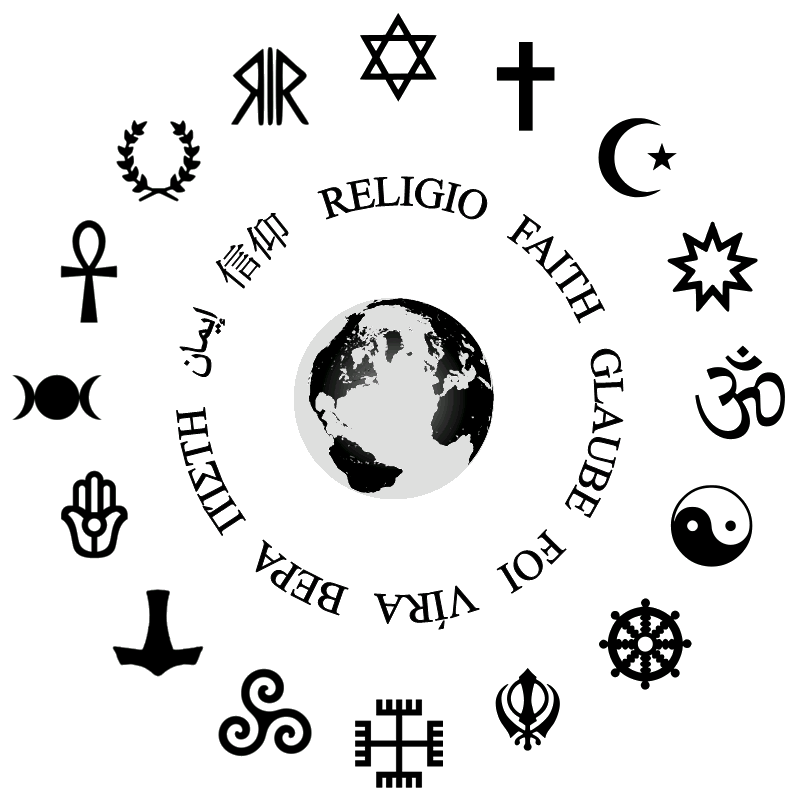
It shouldn’t matter if you read the King James Bible, the Hebrew Tanakh, the Hindi Sanskrit, the Buddhist Tipitaka, or the Muslim Quran… it shouldn’t matter if you study the sky and the stars, or let the soil run through your fingers, or if you are Wiccan, Atheist, Jehovah's Witness, or celebrate Kwanzaa… we are ALL quite literally in this thing TOGETHER. All religions and belief systems share commandments and principles that encourage the love of family, respect for life (human and animal), and provide guidance to help us share this great planet.

I am pleased to say that my family is interfaith. While we each remain true to our individual upbringing, it is a joy to share our unique cultures with each other. It is a blessing to observe the Ruach (Hebrew word meaning energy and spirit) in our rituals. Ultimately our family thrives on LOVE.

So be who you are and practice your faith. And if you find it hard to be compatible with others, don’t meet it with anger and hostility — use it as an opportunity to LEARN about your own and other religions. You’ll be pleasantly surprised at how many similarities there really are. 


Faith should never be divisive; we are all one people in the long run. 

Monday, September 7, 2015

What is religious freedom? ~ #MondayBlogs


The subject has been all over the news – a government official refuses to issue marriage licenses for gay couples; a flight attendant won’t serve alcoholic beverages to passengers; a hobby store refuses to carry any merchandise from all but the owner’s chosen faith; there are stores that won’t open on the Sabbath; holiday displays on public property are considered taboo; one person wants school prayer and another one doesn’t; religious head coverings are questioned; and so many more topics such as is it insulting to some to have the words “in God we trust” on our paper money?

At what point does it become enough? What does it mean to have religious freedom? And is it always persecution if someone loses a job if that religious belief isn’t allowed to be practiced? It seems it’s become too easy to yell religious discrimination when someone doesn’t get their way. There are many factors to consider.

First of all, let me be clear, this is an OPINION piece, MY opinion – there will be people who will disagree and I respect your right to another opinion; however I expect my right to be respected for my beliefs, so please read on…

If you are doing a job with specific responsibilities and tasks and you fail to abide by those rules, is it religious persecution to fire you? I believe that if you took the job with a clear understanding of expectations or if you took a vow to uphold things like, well, like the United States Constitution, then I feel it is not persecution to expect you to do your job. A refusal to do your job should be cause for dismissal or impeachment. Obviously if your boss makes a new rule after you’ve signed on and it would cause you to violate sincere and sacred beliefs, I do think he or she (the boss) needs to make accommodations. By the way, an oath to uphold the constitution is the same even if a new amendment is added. If you are still vehemently opposed to the assigned tasks then it is up to you to give notice and find another job.

In the case of the flight attendant refusing to serve alcoholic drinks, conversion to her faith was made by her choice after already being employed in that position. Although I think it is an unfair burden to ask other attendants to do that part of your job, I do think the individual should sit down with both management and then co-workers to see if there is a solution that would work for all; however, like I said, it does place an unfair burden on other attendants and they should not be penalized if they refuse. The best solution might be to sit with management and find out if there are any positions in the company where this responsibility is not required. Once again since the choices that were made that changed the circumstances belonged to the flight attendant, the ultimate responsibility to correct the situation should be on the shoulders of the attendant.

Head coverings are a different situation. Is there a dress code or uniform it violates? Does the head covering change your physical appearance significantly as in a photo ID? Or is your boss simply concerned that your head covering might offend customers or co-workers? Deciding on whether a head covering is permitted should be considered by individual cases and circumstances. If you’ve been wearing this garment since you took the job and the boss has a sudden change of heart, then this can indeed be discriminatory if you are fired (or in many cases not hired). In the case of official uniforms (it varies between a store clerk uniform or a military officer for example), if the head covering drastically alters the uniform and the uniformity is necessary (such as military) then it might be refused and may be perfectly legal and non-discriminatory.

If you observe the Sabbath and have made it clear during the hiring process that you cannot work that day, if the employer still hires you it would seem to be an understanding that you will not be held responsible; however when a busy holiday season arrives and the boss now demands you put in that specific extra day, if you refuse and you are fired, that sounds to me like discrimination. Many schools allow their students to take off, or might even close for the day, if there is an observance of a religious holiday. If the school is not closed, important and mandatory tests shouldn’t be scheduled on days where observant students would be forced to choose between failing the test or violating their religion. Federal laws require schools to make reasonable accommodation to the religious needs of students and employees in observance of holy days.

According to the Union of Orthodox Jewish Congregations of America “Federal law requires an employer to "reasonably accommodate" an employee's religious observances, practices and beliefs unless the employer can show that accommodation would cause an "undue hardship" to the employer's business. What constitutes "reasonable accommodation" and "undue hardship" depends on the facts unique to a particular situation. Essentially, an employer must attempt to create a structure permitting employees to practice their religious beliefs while still maintaining their jobs. In some cases, accommodation may not be possible.” Reasonable accommodations and undue hardships may be interpreted differently between individual, but I think the key phrase maintaining their jobs is important.

I really like the way this Reverend explains the meaning of religious freedom: "Religious liberty is guaranteed in this country. But that does not mean that every job needs to bend to your particular interpretation of your faith," United Church of Christ's Rev. Emily C. Heath writes. "If you really believe doing your job is violating your faith, then stepping aside would be a small price to pay for the love of the Gospel."


In the meanwhile, let’s try respecting one another and value both our differences and our commonalities.